How Many Words Should Be in a Chapter When Writing Nonfiction?
A guide to ideal chapter length, structure, and reader engagement
Drawing on nearly a decade as a nonfiction editor and book coach, I’ve written this guide to answer a common question on nonfiction authors’ minds: How many words should be in a chapter? It gives ranges and averages, practical tips, examples, and FAQs to help you plan and refine chapters that serve readers, not arbitrary targets.
Key takeaways
Ideal chapter length: 2,500–5,000 words.
Average chapter length: ~4,000 words, varying by genre.
Chapters must be focused, purposeful, and audience‑appropriate.
Use outlines and editing to tighten length and structure.
Prioritize engagement and clarity over hitting a specific word count.
The purpose of chapters in nonfiction
Before diving into word counts and averages, here’s brief reminder on why chapters exist in nonfiction books.
Chapters are not arbitrary divisions; they are structural tools that guide readers through ideas in digestible segments. They exist to:
Organize complex material into manageable sections.
Clarify a single theme or argument per unit.
Navigate the book easily and return to key points.
Improve retention by chunking information.
Control pacing, offering natural breaks and reflection points.
Chapters are the building blocks of a nonfiction book, each one designed to advance the reader’s understanding, sustain interest, and make what you have to say easy to remember.
Structure of a nonfiction book: Parts, chapters, and sections

Most nonfiction books are organized hierarchically:
Parts: Optional divisions grouping related chapters; common in longer works and books with a lot of chapters; use 2–4 parts, if any.
Chapters: Primary units focused on one idea, argument, or step. Most books have 6–20 chapters; 8–12 is the sweet spot.
Sections/Subsections: Optional divisions within chapters, often marked by headings, to break down complex material. Especially useful in books that cover complex or technical material.
This layered approach helps readers follow the logical progression of your argument or instructional process.
Avoid excessive chapter subdivision; as Josh Bernoff cautions, it can overwhelm readers and complicate the book’s layout.
I recommend limiting chapters to 3–5 sections for better flow and less overwhelm for the reader.
Formatting tip: Apply H1 to chapter titles, H2 to sections, H3 to subsections for easier navigation, TOC generation, and layout.
How chapter length affects reader engagement
Chapter length is a powerful tool for controlling the pacing and rhythm of your book. Shorter chapters create a sense of momentum and are more approachable, while longer chapters allow for deeper exploration of complex ideas.
Short chapters (1,500–2,500 words): Fast-paced, bite-sized, ideal for busy readers and actionable books.
Medium chapters (3,000–5,000 words): Balanced, providing depth without overwhelming.
Long chapters (6,000+ words): Suited to narrative, history, or academic work requiring sustained focus.
As Pamela Koehne-Drube notes, “The length of a chapter affects how much information you can give at one time, which, in turn, affects how fast or slow you want your reader to progress.”
Determining chapter length: Genre, audience, and purpose
1. Match chapter length to what’s “typical” in your genre.
Self-Help/How-To: Short, focused, actionable chapters (2,000–4,000 words). Examples: Atomic Habits; You Are a Badass; The Life-Changing Magic of Tidying Up.
Business/Leadership: Medium-length chapters (3,000–5,000 words) with case studies and frameworks. Examples: Start with Why; The Power of Habit.
Memoir/Biography: Longer chapters (4,000–7,500 words) for narrative flow and deeper storytelling. Examples: Steve Jobs; Educated; Becoming.
History/Academic: Longer chapters (5,000–10,000 words, including endnotes), often with sections and subsections for in-depth exploration. Examples: Sapiens; The Silk Roads; Guns, Germs, and Steel. My advice: Use concise endnotes, limited to 15–20% of the chapter word count.
General Nonfiction: Medium-length chapters (4,000 to 5,000 words or longer), within a typical 50,000–80,000 word book: Examples: Blink.
That said, every genre has outliers.
I’ve noticed that older books often have longer chapters; modern books trend shorter—so don’t use older titles as templates. (As an example, Think and Grow Rich includes chapters over 7,000 words, far longer than most contemporary self-help books.)
Average chapter length: How many words in a nonfiction book chapter is typical?
Typical: 2,500–5,000 words per chapter.
Average: ~4,000 words, varying by genre.
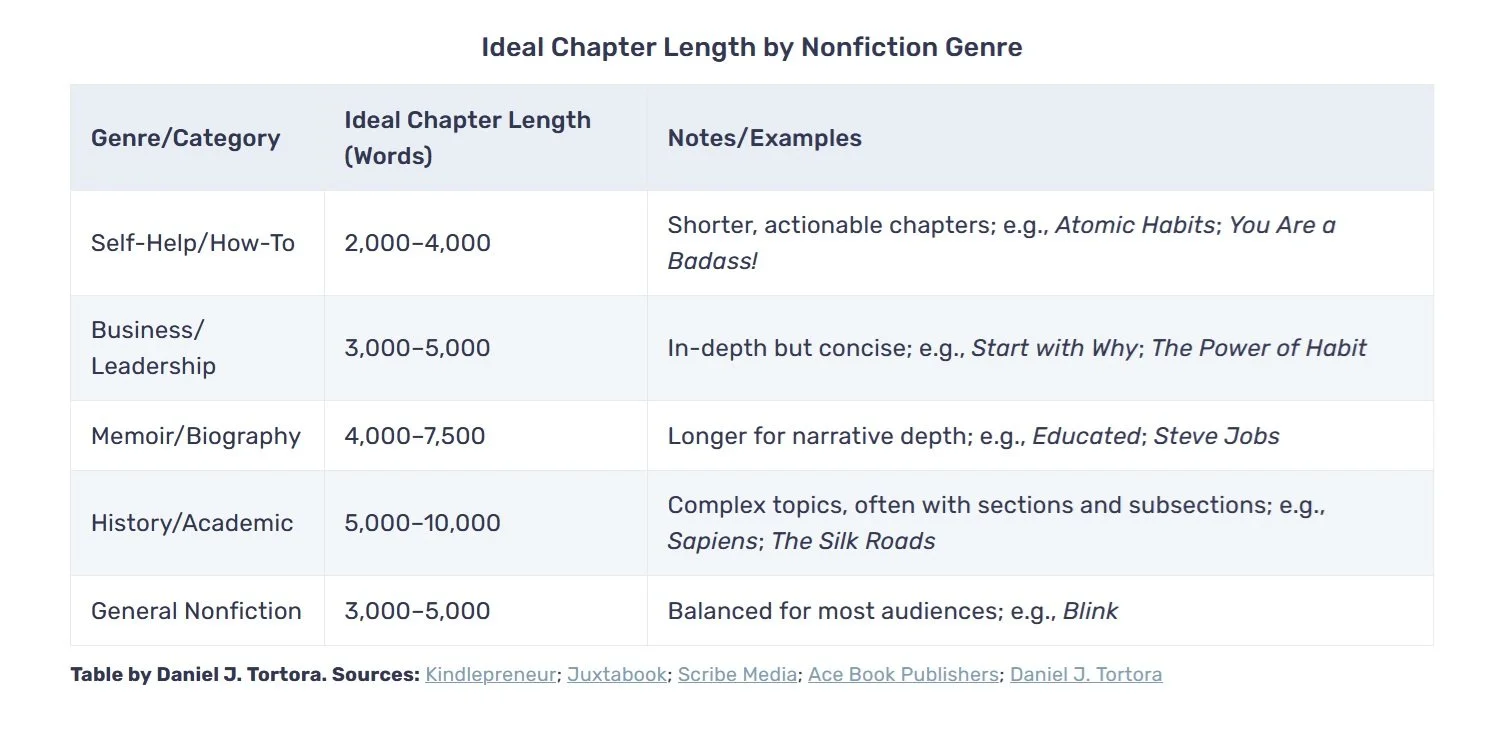
Here’s a summary table of average chapter lengths by genre, with examples. You can find a downloadable image of this table at the end of the article.
Ideal Chapter Length by Nonfiction Genre
| Genre/Category | Ideal Chapter Length (Words) | Notes/Examples |
|---|---|---|
| Self-Help/How-To | 2,000–4,000 | Shorter, actionable chapters; e.g., Atomic Habits; You Are a Badass! |
| Business/Leadership | 3,000–5,000 | In-depth but concise; e.g., Start with Why; The Power of Habit |
| Memoir/Biography | 4,000–7,500 | Longer for narrative depth; e.g., Educated; Steve Jobs |
| History/Academic | 5,000–10,000 | Complex topics, often with sections and subsections; e.g., Sapiens; The Silk Roads |
| General Nonfiction | 3,000–5,000 | Balanced for most audiences; e.g., Blink |
Table by Daniel J. Tortora. Sources: Kindlepreneur; Juxtabook; Scribe Media; Ace Book Publishers; Daniel J. Tortora
2. Consider your reader.
Consider your target audience’s reading habits and preferences:
General readers prefer shorter, more digestible chapters.
Busy professionals appreciate concise chapters with clear takeaways.
Academic and professional readers are comfortable with longer, in-depth chapters.
As Lucid House Publishing notes, “Short chapters can cater to readers looking for quick, digestible sections that fit into hectic schedules,” whereas “longer chapters might be more satisfying for readers who have the luxury of extended, uninterrupted reading sessions.”
Older readers often tolerate longer chapters; younger, internet‑native readers prefer shorter ones.
In today’s digital age, where readers are often distracted or reading in short sessions, shorter chapters can increase the likelihood that readers will finish your book.
Tucker Max reminds us, “Your book is written for your reader, so make chapter decisions based on what makes the best book for them.”
3. Remember that each chapter serves a purpose.
Each chapter should have a clear purpose—whether to explain a concept, tell a story, explore a period of time or a phase in a person’s life, or guide the reader through a process. Don’t try to do “too much” in a chapter.
I agree with Tucker Max when he says, “One mistake I see a lot of authors make is trying to tell the reader everything there is to know about a subject. You’re far better off leaving your readers wanting more than you are boring them.”
Each chapter should serve a single purpose: It should explain a concept, tell a story, cover a period or life phase, or guide a process.
Avoid the all-too-common mistake of cramming too much into one chapter. As Tucker Max warns, “One mistake I see a lot of Authors make is trying to tell the reader everything there is to know about a subject. You’re far better off leaving your readers wanting more than you are boring them.”
Writing strategies: Write from an outline
A detailed outline is invaluable for determining chapter length and structure.
When outlining, consider:
The main message or takeaway for each chapter.
The logical progression of ideas.
The balance between depth and conciseness.
Chapter structures:
Lists: Organize chapters around lists of concepts, tips, or resources.
Steps: Break down processes into sequential steps, dedicating a chapter to each.
Case Studies: Use real-life examples to illustrate key points.
Stories: Use stories to illustrate key points or shine light on a period of time
Clear Structure, Expert Feedback, Forward Motion
Get a chapter‑by‑chapter outline, a practical next‑step roadmap, and two one‑on‑one coaching sessions—everything you need to write with confidence.
Get expert feedback on your drafted chapter or manuscript—a professional read, clear revision steps, and a written action plan to strengthen structure, voice, and pacing.
Editing strategies
When planning or revising chapters, try these strategies:
Combine short chapters: Merge chapters that feel insubstantial or repetitive or expand them with examples, stories, or actionable steps.
Split long chapters: Divide chapters that cover multiple ideas or exceed 7,500–10,000 words.
Use scene or section breaks: Insert breaks within chapters to aid navigation and provide natural pauses.
Trim or expand as needed: Cut unnecessary material or add examples, stories, or actionable steps to achieve balance.
Get feedback
Most authors are too close to their work to judge chapter length objectively, so enlist beta readers or a professional editor.
Ask reviewers to pinpoint which chapters felt too long or short, where attention flagged, and which breaks felt natural, then use those notes to split, tighten, or expand chapters.
Iterative feedback—especially from a professional editor—helps you fine‑tune your chapter pacing and maximize reader engagement.
➡️See my nonfiction editing services for US authors.

How long should a chapter be?: Frequently asked questions
Q. How many words in a nonfiction book chapter is too short or too long?
A. Under 2,000 words may feel insubstantial unless it serves a specific purpose (e.g., a brief introduction or summary).
7,500–10,000 words can overwhelm readers and may indicate the need to split the chapter. If your chapters are longer than normal, break them up with section headings or section breaks, images or graphics, or visual elements. I’m not a fan of section breaks, as I feel it interrupts the flow.
Aim to write chapters that give the reader what they need—no more, no less. All things being equal, aim for the average chapter length for your genre.
Q. Should all chapters be the same length?
A. No. It’s more important for chapters to be relevant and focused than to be uniform in length.
That said, extreme variation often signals structural problems: it can overwhelm readers or leave them underfed.
Aim for consistency where possible. I advise authors to keep chapters within ±10% of your average (excluding the intro and conclusion). As an example, for a 4,000‑word average, your word count target would be 3,600–4,400 words.
Ignore this rule only when a setup chapter or a distinct section legitimately needs to be shorter or longer.
Q. How many chapters in a nonfiction book is typical?
A. Most nonfiction books have 8–20 chapters; 8–12 is the common sweet spot. If you have many chapters, consider grouping them into parts.
Q. What is the average word count for a nonfiction book?
A. The average nonfiction book ranges from 50,000–80,000 words, and keeping within those parameters is a firm requirement for traditional publishing.
Self-published books can be longer or shorter than the 50,000–80,000 range. And some biographies, especially by experienced authors, can approach or top 100,000 words.
Genre matters, however; focused self-help books can be much shorter.
➡️See What’s the Ideal Word Count for a Nonfiction Book? for a break down of average word count in a nonfiction book, by genre.
Q. How do I decide where to end a chapter?
A. End a chapter when you’ve fully explored one idea, completed a logical step in your argument or process, or reached a natural pause in the narrative.
Effective endings either provide closure, so the reader can clearly state the chapter’s takeaway or create momentum, using a cliffhanger, a provocative question, or a transition that points to what comes next.
Avoid cutting off mid‑thought; each chapter should feel like a complete unit that either resolves something or propels the reader forward.
Conclusion: In a nonfiction book, how long should a chapter be?
So, how many words in a nonfiction book chapter is ideal?
There is no firm rule. It depends on your genre, audience, purpose, and the unique needs of your book. However, here are some guardrails:
The average chapter in a nonfiction book is 4,000 words.
The typical chapter length in a nonfiction book is 2,500–5,000 words per chapter.
Focus each chapter on a single idea or theme. Keep chapters focused and purposeful.
Vary chapter lengths—within reason—to control pacing and maintain engagement.
Write from an outline and work with an editor to refine your chapters. (I help nonfiction authors create and fine-tune outlines, chapters, and full manuscripts.)
Prioritize quality and relevance over hitting a particular word count.
The ideal chapter length is whatever best delivers your message and keeps your readers turning pages.
Related articles:
Download the table as an image: