How to Get Your Book into Libraries: A Practical Guide for Authors
How to get your book into libraries
Getting your self‑published book into libraries is one of the smartest long‑term discovery strategies an indie author can pursue. Libraries expose your work to voracious readers, build credibility, and create steady revenue if you understand library distribution, pricing models, and how librarians select titles.
This guide walks you through how to get your book into libraries, step‑by‑step, with practical checklists, pricing guidance, outreach templates, and the distributor options that matter.
Why libraries matter for indie authors
Libraries are one of the most powerful discovery tools available to indie authors.
“Because checking out books from libraries is free, patrons are more likely to try unfamiliar authors,” says Jim Azevedo, Corporate Communications Manager for Draft2Digital.
“If that weren’t enough, research consistently shows that library patrons are more voracious readers and are more likely to purchase books than non-library users.”
A single checkout can turn a casual browser into a long‑term fan.
Library catalogs also keep ebooks and audiobooks visible for years, giving your work long‑term discoverability.
It’s easier than ever for self‑published authors to reach libraries through distributors like Draft2Digital, PublishDrive, StreetLib, and IngramSpark. Kindle Unlimited authors can now participate, too. As of September 2025, KDP Select enrollment requirements now permit KU books to be “distributed through KDP and public libraries.”
While library pricing is higher than retail pricing and royalty rates are good (Draft2Digital, negotiated a 46.75% rate for OverDrive sales) and authors do make money from library sales, it’s only a small fraction of their overall earnings. The authors I spoke to make about 10% of their earnings from libraries.
The main return is exposure. Librarians buy, readers discover, and that discovery often drives sales, mailing-list signups, and social media followers.
How libraries boost your book marketing
Circulation and catalog placement put your title in front of readers who wouldn’t find it otherwise.
Checkouts often lead readers to explore and buy other titles you’ve written.
Library purchases and listings signal credibility to other buyers and reviewers.
Readings and library events convert patrons into followers and subscribers and can open doors to new opportunities for authors.

Library distribution is worth the extra work. Now here’s how to get your book into libraries.
Step 1: Make your book library‑ready
Before distribution, make sure your book meets professional standards:
ISBNs: Assign an ISBN for each format (ebook, audiobook, print).
Professional files: Libraries expect professional production. That means a high-quality cover and clean EPUB file (for an ebook), proofread PDF for a print book, or audio files for an audiobook.
Metadata: Prepare keywords, BISAC subject headings (categories), and a book description.
Reviews and endorsements (ideally): Solicit reviews and endorsements.
Librarians look to library-specific review outlets like Library Journal, Kirkus, and Foreword to gauge the quality of a book. Most of them report directly to the distributors’ catalogs. Some of the ones used by indie authors include: Kirkus Indie Reviews, Booklist, BookLife, Feathered Quill Reviews, Foreword Reviews, and BlueInk Review.
Endorsements may also be useful.
Remember, you can also use selected quotes from reviews and endorsements as Amazon “Editorial Reviews” on your book’s Amazon page and on your website.
Local relevance: Libraries favor recent titles and local authors; note local ties in your pitch.
These preparation steps make your title more likely to be discovered and purchased by library selectors.
Step 2: Choose the right distributor
To get into library platforms, you must use a distributor.
Libraries don’t buy books from Amazon for their catalogs.
You cannot walk into a library with a USB drive or email a PDF and expect a purchase. In most cases, you can’t sell or hand them a print book and ask them to put it on the shelves.
Libraries acquire ebooks, audiobooks, and print books through dedicated library platforms so they can manage cataloging (MARC records).
For print books: For most authors, IngramSpark is a perfect choice.
For ebooks and audiobooks: Some popular distributors include Draft2Digital, PublishDrive, StreetLib, and, to some degree, Kobo Writing Life.
For audiobooks only: Some popular distributors include Voices by INaudio, Author’s Republic, and Lantern Audio.
For school and university libraries, the most popular distributors include IngramSpark, StreetLib, and PublishDrive.
This is not a comprehensive list or a one-size-fits all. Some authors use more than one distributor. Always check distribution partners and eligibility before uploading.
Libraries operate under fixed budgets and formal selection policies, so availability through a distributor is only the first step toward being purchased and cataloged. Later, I’ll share some strategies with you to increase your odds of selling books to libraries, but first let’s look at library distribution.
Top library platforms and how to reach them
Here are the largest library platforms or apps and the distributors who serve them.
The world’s largest library ebook and audiobook platform. “OverDrive now offers the largest digital content catalog in the world to more than 92,000 libraries and schools in 115 countries” (source: Overdrive website), mainly in North America, Australia, the UK, Germany, and Japan. Titles are accessed by patrons via the Libby app. Distributors: Draft2Digital, Kobo Writing Life, PublishDrive, StreetLib, IngramSpark, Voices by INaudio, Author’s Republic, Lantern Audio.

Hoopla supplies digital media to 11,500 libraries and 7.5 million patrons worldwide, but mainly in the US and Canada. Hoopla’s model allows patrons to borrow content instantly. Hoopla uses a CPC (cost-per-checkout payment model) and does not allow for price changes. Distributors: Draft2Digital, PublishDrive, IngramSpark, Voices by INaudio, Author’s Republic, Lantern Audio.

BorrowBox, owned by Bolinda Digital, serves library and school markets—especially in Australia, New Zealand, and the UK. Distributors: Draft2Digital, IngramSpark.

cloudLibrary is a digital content platform owned and operated by OCLC, a global library nonprofit. While it has a smaller reach than some of its competitors, it is rapidly growing. Distributors: Draft2Digital, Voices by INaudio, Author’s Republic, Lantern Audio.
Other popular library platforms
Here are some other library platforms who serve specific regions or library types, including school, academic, or regional public systems.
EBSCOHost: Especially for nonfiction, academic, and educational titles; it reaches academic and public libraries worldwide. Distributors: IngramSpark.
Mackin: A US‑based distributor providing content to 50,000 school and youth libraries (PK–12). Ideal for children’s books, YA, middle grade, and educational nonfiction. Distributors: PublishDrive, IngramSpark, Author’s Republic.
Odilo: Offers ebooks and audiobooks (among other digital media) to 30,000 institutions in Spain, Portugal, Mexico, the US, Australia, Latin America, and the Middle East. Distributors: Draft2Digital, StreetLib, IngramSpark, Voices by INaudio, Author’s Republic, Lantern Audio..
Palace Marketplace (The Palace Project): A nonprofit ebook marketplace created by the Digital Public Library of America (DPLA). It serves 400+ US public libraries and pays authors 60% of the list price. Distributors: Draft2Digital.
ReteINDACO: An Italian national digital library network. Distributors: StreetLib.
Check distributor partner lists for exact coverage. Pick a distributor that lists the platforms you want. Some authors use multiple distributors over time to expand reach.
Step 3: Set library pricing; know how to price your self‑published book for libraries
How to price your self‑published book for libraries depends on the platform and licensing model.
Libraries expect to pay more for a license—at least 2–3× the normal retail price.
OCOU (One Copy, One User): Libraries buy a license/copy; ebook library pricing is often 2–3× the retail ebook price to reflect library licensing and to match publisher pricing expectations. Authors will often make 45 to 55% of the list price per one-time sale.
CPC (Cost-Per-Checkout): Also known as “Cost-Per-Circ.” Libraries pay per loan (10% of list price or a tiered rate); CPC increases discoverability because libraries can offer unlimited simultaneous access for a per‑loan fee.
Metered access (MA) or subscription (SU) models: Some vendors use time‑limited or number-of-checkouts-limited licenses; these generally apply only to traditional publishers.
Here’s how that looks on Draft2Digital. Note that Draft2Digital pays 46.5% of the list price under the OCOU model:
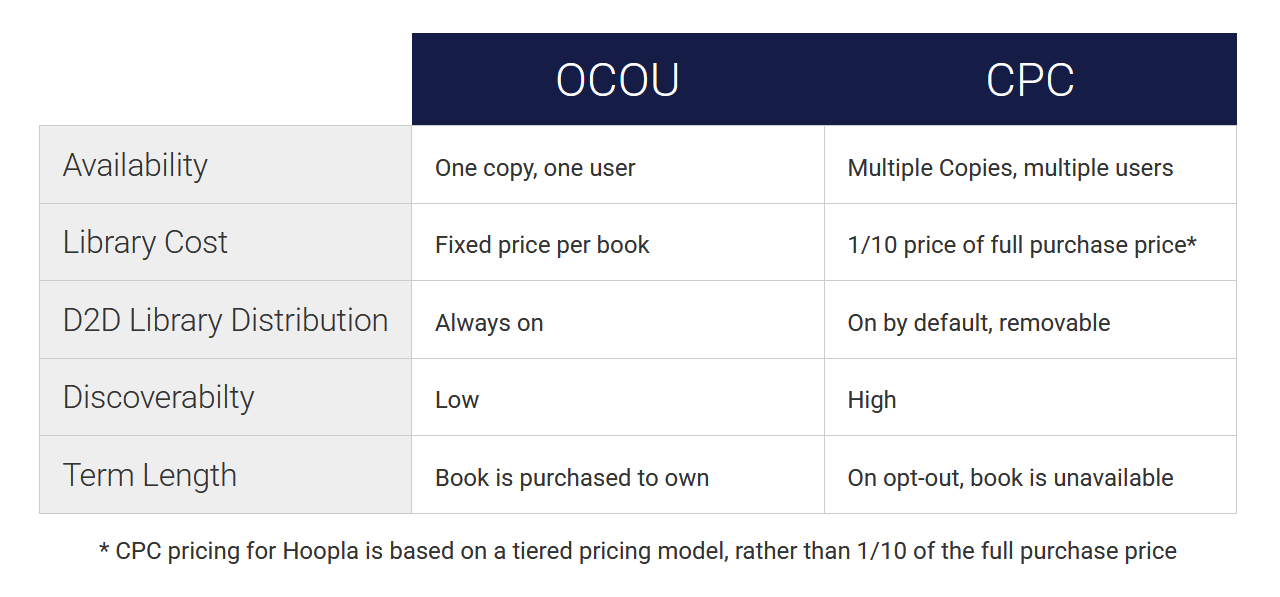
Practical rule: Set a library list price that reflects the platform’s expectations (often higher than retail ebook price) and enable both OCOU and CPC where available to maximize purchase and checkout opportunities.
Library books cannot be listed for free; the minimum price is US $0.99.
➡️Read Draft2Digital’s best practices for library distribution for self-published books.
Get your nonfiction book into readers’ hands!
Move from “how” to “done” with an experienced book coach—
strategy call, custom publishing plan, or 1:1 marketing help.
Limited spots for US nonfiction authors; act now.
Step 4: Distribute and confirm platform availability
Upload your files and metadata to your chosen distributor and opt into library distribution channels. Confirm which platforms your distributor will submit to and check the expected timeline—some platforms take weeks to ingest new titles.
After distribution, record the platforms and ISBNs on a one‑page “one‑sheet” you’ll use when contacting librarians. (At the end of this article is an email outreach template and a one-sheet punch list.)
Step 5: Create demand by asking readers to request your book
As I said earlier, just because your book is available through a distributor doesn’t mean libraries will know about it or that they’ll buy it.
Libraries often purchase titles based on patron requests.
Encourage readers to request your book through their library’s request form or via the library app. The more, the better! So mobilize your local network and email list.
As Kevin Tumlinson notes, “It takes a bit for books to appear in the catalog, once they’re ordered. You can expect a 14- to 21-day wait, in most cases. So the sooner you ask for it, the sooner it’s there for other patrons to discover.”
In my experience, it could take weeks or even months, depending on depending on library budgets and ordering habits.

Step 6: Pitch to librarians
Reaching out to libraries
Make it easy for a librarian to say yes by being concise, professional, and local. Combine a short, targeted email with a polished one‑sheet and clear offers that increase the book’s value to the library.
Before you visit or email (preferred)
Bring or share a printed one‑sheet, a flyer listing the basic details about the book that will help the librarian evaluate the book and locate it for purchase. See below for more details.
Research the acquisitions or collection development contact first.
Be ready to submit materials online if requested. An outreach template is provided below.
Build relationships: regular, friendly contact with local librarians pays off.
When pitching to acquisitions or collection development librarians, include:
Evidence of demand: local interest, event attendance, pre-orders, or patron requests.
An offer to share a copy of the book or to volunteer to give a talk or do a reading at the library. A local event could increase the title’s value to the library and could result in more new readers for your book(s).
Librarians evaluate many signals, including reviews, patron requests, publisher/distributor announcements, and curated buy‑lists, so make it easy for them to say yes.
Remember that it also helps to get reviews in publications and review services that librarians consult!
Selling self-published books to libraries: Common obstacles and how to overcome them
Visibility: Self‑published books can be overlooked; secure reviews, endorsements, and local buzz and patron requests to stand out.
Budget: Review fees, distributor costs (some are free; some charge a monthly or yearly fee), and donation copies add up—budget for promotion.
Platform rules: Some platforms (e.g., Hoopla) lock pricing once you’ve opted in; check terms and partners before you submit.
Industry shifts: Distributor and vendor landscapes change; one large library distributor (not listed here) went out of business in 2025.

Checklist for selling books to libraries
[ ] Get ISBNs for each format.
[ ] Produce a professional EPUB and cover.
[ ] Choose distributor(s) and opt into library channels.
[ ] Set library pricing (consider 2–3× retail for OCOU; enable CPC).
[ ] Create a one‑sheet with ISBN, platforms, price, and blurbs.
[ ] Ask readers to request your book at local libraries.
[ ] Email acquisitions librarians with your one‑sheet and request form link or hand-deliver your one-sheet.
[ ] Offer to give an author talk or review copy to local branches.
Summary: Getting your self-published book into libraries
Getting your book into libraries is a marathon, not a sprint. Use a reputable distributor, set library‑friendly pricing, prepare professional files and metadata, and do the outreach needed to create demand.
Libraries are increasingly open to indie authors—especially local authors and titles with demonstrated reader interest, so be persistent, professional, and patient. With the right distribution strategy and a focused outreach plan, getting your book into libraries can become a reliable channel for readers and revenue!
Useful links for getting your book into libraries
Book Coaching Services for nonfiction authors (US)
Best Practices for Indie Author Library Distribution (from Draft2Digital)
Sell your books to libraries using the top library distributors: IngramSpark, Draft2Digital, PublishDrive, StreetLib, Kobo Writing Life, Voices by INaudio, Author’s Republic, Lantern Audio
Librarian pitch email template
Subject: Purchase Request for [Book Title]—Available on [OverDrive/Hoopla/cloudLibrary/etc.]
Dear [Librarian Name or “Collection Development Team”],
My name is [Your Name], and I’m a local author in [Your City/County]. I’m writing to ask if you would consider adding my book, [Book Title], to your library’s digital collection. It is available through existing library vendors, including [OverDrive/Libby, Hoopla, cloudLibrary, BorrowBox, Palace Marketplace, Odilo—list only the ones that apply].
About the book
[1–2 sentence hook about the book]
Genre/Category: [BISAC category]
Publication Date: [Month Year]
ISBN (ebook): [ISBN]
ISBN (print, if applicable): [ISBN]
Why it may be a good fit for your collection
Strong interest from local readers (several patrons have expressed interest)
Positive early reviews: “[Short blurb or endorsement]”
Suitable for readers of [comparable authors or topics]
Professionally edited and formatted to library standards
I’ve attached a brief one‑sheet with full details, including pricing, metadata, and distribution platforms. I’m also happy to provide a review copy upon request.
Thank you for supporting authors and readers in our community. I would be grateful if you would consider adding [Book Title] to your collection.
[Your closing greeting],
[Your Name]
[Your Website]
[Email Address]
[Optional: Phone Number]
[Optional: Social Media]
One‑Sheet template
You can paste this into Canva, Google Docs, or Word and add your branding and some pizzazz. The final product should fit on a standard size sheet of printer paper. Generally it would be designed in color and emailed as a PDF, though it can be printed.
[BOOK TITLE]
by [Your Name]
[Insert book cover image here]
BOOK DETAILS
Author: [Your Name]
Publisher: [Your Publisher Name or “Independently Published”]
Publication Date: [Month Year]
Format(s): Ebook / Print / Audiobook
ISBN (ebook): [ISBN]
ISBN (print): [ISBN]
ISBN (audiobook): [ISBN]
Length: [Page count or hours]
Category / BISAC: [Primary category]
SHORT DESCRIPTION
[Write a concise summary of the book (under 100 words). Focus on what the reader will learn, experience, or enjoy. Avoid marketing hype—librarians prefer clarity.]
LONGER DESCRIPTION
[Expand on the book’s purpose, audience, themes, and value. A bulleted list is appropriate. Mention comparable titles or authors. Keep the tone professional and informative.]
AVAILABILITY FOR LIBRARIES
Your library can purchase [Book Title] through the following platforms:
OverDrive
Hoopla
cloudLibrary
BorrowBox
Odilo
Palace Marketplace
Mackin
EBSCOHost
ReteINDACO
[List only the platforms your distributor actually reaches.]
LIBRARY PRICING
Library Price: $[Price]
Model: OCOU (One Copy, One User) and/or CPC (Cost Per Checkout)
REVIEWS & ENDORSEMENTS
“[Insert short review quote]” —[Reviewer Name]
“[Another short blurb]” —[Publication or Endorser]
Awards or distinctions:
[Award or recognition, if any]
[Local press coverage, if any]
ABOUT THE AUTHOR (50 words)
[Short author bio. Mention local connection—libraries love supporting local authors.]
[Insert author photo (optional)]
CONTACT
[Your Name]
Email: [Your Email]
Website: [Your Website]
Social: [@YourHandle]