15 Amazon KDP Self‑Publishing Mistakes That Will Cost You Readers
15 Amazon KDP Mistakes to Avoid: My Top Tips for Authors
Look Like a Pro, Find More Readers, and Sell More Books
It’s exciting to publish a book, but readers are discerning and the market is crowded. If you’re self‑publishing on Amazon, you run the risk of unknowingly making mistakes that turn readers off, hurt sales, and damage your reputation.
That is, unless you read this article...
To make a great impression and come across as credible and professional when self‑publishing, check these tips below, pulled from my many years of experience as a nonfiction book editor and publishing coach for US authors.
Mistake #1: Bad covers that don’t reflect the subject
Your cover must reflect the book’s essence. It should resemble new and popular book covers in your genre.
Your cover must reflect the book’s essence and resemble current, popular covers in your genre. Browse other covers in your category to learn recent conventions: For example, history books often use beige backgrounds and may incorporate portraits, flags, maps, or archival imagery. Business and self‑help books are often more minimalist. Choose a font that fits the genre. A haphazard collage of misaligned photos looks chaotic and is likely not the best option.
Ideally, work with a professional cover designer who understands the principles that attract readers in your genre.
Mistake #2: Poor descriptions
A great book description sells. A book description (sometimes called a book blurb) is NOT a summary; it’s sales copy.
Begin with a bold tagline that captures the book’s essence or promise. Then follow the AIDA method (Awareness, Interest, Desire, Action).
Break the description into short paragraphs with white space, use bold text and bullets where helpful, avoid first person, and always include a clear call to purchase

Mistake #3: Weak or improperly formatted titles and subtitles
Your title and subtitle must tell readers what the book is about and, when appropriate, who it’s for or how it helps them. Include important keywords readers search for. Use proper capitalization (Chicago Manual title case capitalization) and punctuation: Title in Caps: Subtitle. If you include the subtitle on the cover, omit the colon there. If your title includes date ranges, separate them with an unspaced en dash.
Mistake #4. A nonexistent or lackluster author bio
Your About the Author section is an opportunity to reinforce credibility and briefly connect with readers. It should appear both in the back of your book and online, with a photo!
Avoid vague details. Be specific—“a mom” is less compelling than “a mom to three teenage daughters” or “a former policy analyst” or “a master’s-division competitive swimmer.”
Give readers a way to follow you online, visit your website, and/or take some other mutually beneficial action. Show readers you are a real person who is credible, interesting, and approachable.
Mistake #5: Not adding any endorsements or Editorial Reviews
Endorsements and snippets of praise from paid or unpaid reviewers from anyone other than regular readers (think media, bloggers, experts, other authors, public figures, etc.) should be included on your book cover (or even inside your book) and certainly in the editorial reviews section in Amazon and other platforms.
Place these quotes on your website and consider creating social media graphics with them. Consider paid professional reviews if you need expert endorsements.
➡️Learn more: Amazon Editorial Reviews: How to Add in Author Central
Mistake #6: Not asking for reader reviews
Are you asking readers to leave reviews? Include a short request in the back of your book. If you’re publishing your book to more than one retailer, keep the request generic
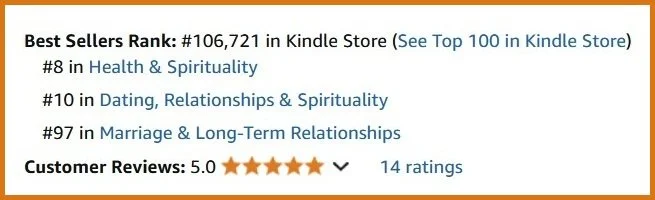
Review count and average rating appear in Amazon listings and ads. Your goal should be to get at least 10 reviews—legitimate, honest reviews, as soon as possible. (Below is the sales rank of a book I edited recently.)
➡️Learn more: How to Get More Book Reviews on Amazon
Mistake #7: Not creating an Amazon Author Central page
Readers want to learn about authors of books they read or are interested in buying, and they want to see that authors are real humans.
An Amazon Author Central page lets you add a bio and headshot (which increases sales and helps readers find you elsewhere), display editorial reviews, show all your books on one page, and give readers a way to be notified by Amazon when you publish again.
➡️Learn more: How to Edit Your Amazon Author Page in Author Central
Mistake #8: Word count is inconsistent with the genre
Part of the appeal of self-publishing is that you have creative flexibility. But readers still expect genre conventions. They probably don’t want your convention-flouting decisions.
While nonfiction can range widely in word count (from 25,000 to 80,000 words or more), it’s best to fall within the average range for your genre. It’s what readers are used to, what gets the job done, and what fits with pricing considerations.
A 404‑page self‑help book can intimidate readers; a 532‑page history book may be too long for general audiences; an 82‑page history book can feel insubstantial.
➡️Learn more: What’s the Ideal Word Count for a Nonfiction Book?

Mistake #9: Ignoring a style guide/not working with a copy editor
Your book should follow publishing industry standards. Use a recognized style guide, ideally The Chicago Manual of Style. You can’t go wrong there, since that’s what nearly all of the publishing industry uses.
Many embarrassing errors—using superscripts for ordinals, misspelling “foreword,” inconsistent number formatting, incorrect quotation marks or apostrophes, improper paragraph indentation, incorrect hyphenation, or random shifts in tense or point of view—are avoidable.
At minimum, you should work with a professional copy editor or proofreader.
➡️Learn more: Line Editing vs. Copy Editing: What’s the Difference?
(Get a copy of The Chicago Manual of Style, 18th edition today!)
Mistake #10: Pricing mistakes
Know and follow pricing conventions for your genre. Price competitively: too low and readers assume low quality; too high and few will buy unless the book clearly screams “premium” and they know you.
That said, some authors I’ve worked with have (successfully) adopted the strategy of pricing one format slightly lower or higher to incentivize sales for a particular format, or by running periodic ebook and audiobook promotions.
Book prices—list prices—almost always end in .99.
➡️Learn more: Tips for Pricing Self-Published Books
Mistake #11: Not asking people to buy
Authors who avoid promotion because they don’t want to seem “pushy” miss out. You’re not being “salesy.” You’re playing matchmaker. You’re giving people what they want or need.
Balance value and outreach—don’t ask for a purchase every post, but do include clear, helpful calls to action across your email newsletter and social channels.
Mistake #12. Not having an author website or easy contact method
At minimum, have a modern author website and an Amazon Author Central page.
Your site should display your cover, include buy buttons (or universal book links) linking to major retailers, offer a contact form, and provide an email sign‑up (ideally in exchange for a relevant freebie). It doesn’t have to be fancy; a one‑page landing page will do.
Mistake #13: Relying on AI for keyword selection
I hate to break it to you, but ChatGPT does not know Amazon-specific search volume for particular words or phrases that people might be searching for in Amazon. The SEO software I use does—and I advise authors on what keywords to input into KDP when publishing their nonfiction books.
Whenever you’re choosing and entering keywords—or any metadata, for that matter—check everything twice. Mistakes here reduce discoverability and sales.

Mistake #14: Rushing the release
A hurried launch usually shows: sloppy formatting, missed editorial fixes, weak metadata, and a thin marketing plan.
Give yourself time for a coordinated pre-launch: Choose a date that makes sense for your book. Consider setting up a pre-order on Amazon, too. Order author review copies (which take several days to arrive) and schedule promotional outreach. Recruit advance readers, finalize and review your metadata and pricing, to review the book when it’s live.
A deliberate timeline builds hype, builds in time for unexpected delays, and maximizes the impact of your first weeks on Amazon.
➡️Learn more: What Is the Best Month to Publish a Book?
➡️Learn more: Amazon KDP Pre-Order Strategy for Authors
Mistake #15: Not writing books in a series
Readers who love a topic often want more—more depth, more examples, more practical next steps.
A single standalone title can perform well, but a planned series creates discoverability, repeat purchases, and a clear reader journey from entry‑level to advanced material.
For nonfiction, structuring your content so each book solves a distinct problem while pointing to the next installment builds momentum and makes marketing easier (you can do boxed sets, bundles, and sequels).
If you think you want to write multiple books, a chat with a publishing coach can help you design a plan that you’re excited about.
In any case, map a series arc before you publish so each book reinforces the others and increases lifetime value. If your books aren’t closely related, it’s so much harder to gain momentum.
Next steps
If you’re reading this and thinking, “Uh oh,” or “I don’t know how to avoid that,” working with a book coach can help you prioritize fixes, navigate the self‑publishing process, and create a launch plan that converts readers into buyers.
If you’re a nonfiction author based in the US and are looking for some guidance, book a coaching session to get a customized checklist and step‑by‑step support for self‑publishing success.
If you’re still in the writing phase and need line editing or copy editing to sharpen your manuscript, tell me about your book so I can talk with you and provide a plan and a quote for editing.
In the meantime, you’ll find plenty of additional resources for nonfiction authors on writing, editing, publishing, and book marketing on my website as well as digital products for nonfiction authors to guide you. You got this!