Choosing BISAC Codes for a Book for Increased Discoverability and Sales
Have you ever walked down the freezer section at the grocery store? Imagine a beautifully lit freezer case full of pints of ice cream. (Talenti, I see you!) But smack-dab in the middle of it is a box of frozen cream puffs. Those cream puffs are probably amazing, but whoever came to the store looking for those cream puffs might never find them.
Now picture your ideal reader typing “dating after divorce” into an online bookstore search or browsing the shelves of a two-story Barnes & Noble and being funneled into a broad, generic self‑help selection. Algorithms and category labels nudge them past your book before they even see the subtitle.

If your BISAC categories don’t match your audience, your title is the cream puffs in the ice cream case. It might be your dating book that’s shelved in the wrong virtual or physical aisle and is never found or is overlooked. As a nonfiction publishing coach who has helped hundreds of authors, I see this mismatch all the time—choosing the right BISAC “address” is a small piece of metadata with a big impact.
Choosing the right “address” for your book is one of the most important pieces of metadata you’ll ever handle.
Drawing on a decade of experience guiding nonfiction authors through the writing and publishing process, I’m writing today to explain what BISAC codes are and how to pick the categories that actually sell books.
What Is a BISAC Code?
What does BISAC stand for? BISAC stands for Book Industry Standards and Communications. These are the industry-approved subject descriptors used by libraries, retailers, and bookstores to catalog and classify your book.
What are BISAC codes used for? Shelving, online filters, merchandising, reporting, and discoverability.

How many BISAC codes are there? The BISAC (Book Industry Standards and Communications) Subject Headings, managed by the Book Industry Standards Group (BISG) are organized into 54 broad top‑level categories and nearly 6,000 distinct alphanumeric codes, allowing publishers and authors to classify titles down to very specific subgenres and topics.
Each code is a nine-character alphanumeric string that tells retailers exactly where your book belongs.
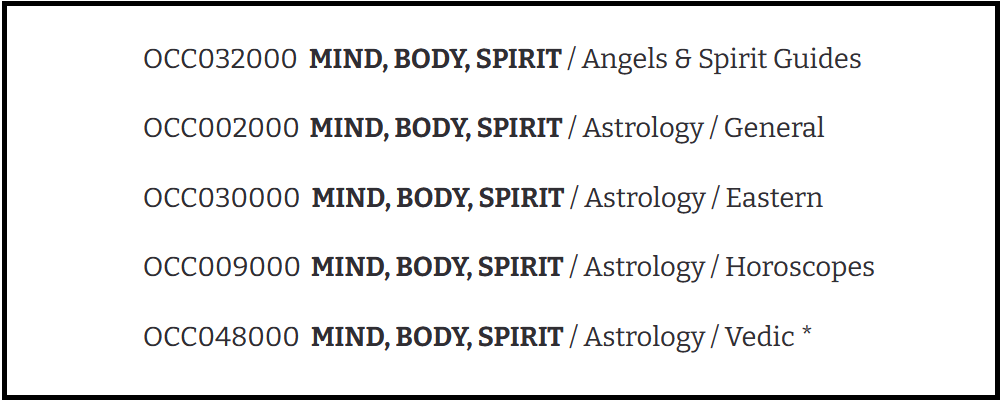
(Here is the the Complete BISAC Subject Headings List.)
The terms “BISAC subject codes,” “BISAC categories,” and “BISAC codes” are used interchangeably, although technically, “codes” refers to the nine-character string, and “categories” refers to the broad-level classification.
BISAC vs. Thema vs. BIC: What’s the difference? BISAC is North America–centric and alphabetical; Thema is multilingual and more granular for global markets. BIC was a subject category system for the UK book trade; it was replaced by the Thema classification standard.
Platform Rules: Which Publishing Platforms Use BISAC Categories?
Before I became an editor and author coach, I spent time as a radio DJ. Each radio station ran a little differently in terms of how we logged the music played. Publishing is the same—different platforms have different rules for what information they require of authors and publishers.
IngramSpark, Draft2Digital, PublishDrive, Apple Books, and Google Books use BISAC categories.
Amazon KDP and Kobo Writing Life do not.
IngramSpark uses BISAC subject codes. It requires at least one code but recommends up to three specific codes to improve discoverability and also supports Thema subject categories.
Draft2Digital uses BISAC codes. Not all partners it distributes to require three, so select in order of relevance.
PublishDrive uses BISAC and lets you choose up to three categories; you can type in or select codes from a list. Or you can use the AI metadata tool Savant; it automatically reads your uploaded content and suggests the most relevant BISAC categories, which you can then accept or reject. Important tip: Choose your BISACs in order of relevance.
Google Books uses BISAC subject headings, recommends three (but has no limit), and converts other category systems to the nearest BISAC equivalents (perfect for authors unfamiliar with the BISAC system).
Apple Books uses BISAC subject headings and requires a main subject plus a secondary BISAC subject to help readers find your book.
Amazon KDP does not use BISACs. Instead, KDP uses its own Amazon Store categories. When publishing on KDP, you select up to three specific Amazon store categories. This helps determine where your book is listed on the Amazon website.
Kobo Writing Life (KWL) does not use BISACs; it uses a simplified BISAC-like category system.
Tip 1: Specificity Is Your Secret Weapon
The biggest mistake I see? Choosing “General.”
If you select HISTORY / General, for example, you are competing with every history book ever written. Instead, niche down. The narrower the heading, the easier it is for your target audience to find you.
Likewise, if you’ve written a book about Southern travel, don’t just pick “Travel.” Use TRV025070 TRAVEL / United States / South / General.
“We recommend that you use the most specific codes possible for your book,” BISG says on its BISAC FAQ page.
“The practice of supplying both a specific and a general subject heading on a given product is discouraged,” BISG adds. “The more specific the codes, the more useful it is to you and your book.”
Tip 2: Think Like a Bookseller and a Reader
When you’re sifting through the 54 major sections of the BISAC list, ask yourself: Where would my ideal reader expect to find this book on a physical shelf?
When selecting BISACs, try to determine the most ideal fit.
Tip 3: Check Out the Competition
Don’t guess. Do the research.
If the most similar (and ideally selling like hotcakes) books in your niche are all under a specific subheading, that’s a loud-and-clear signal that you should be there, too.
Is there any way to look up BISAC codes for a specific book? Yes. You can look up your “comps” on Books-A-Million, Google Play Books, or Bookshop.org to see what categories they use.
For the retailers I’ve mentioned, if you scroll to the “Book Details” section, you’ll see how the book is categorized.
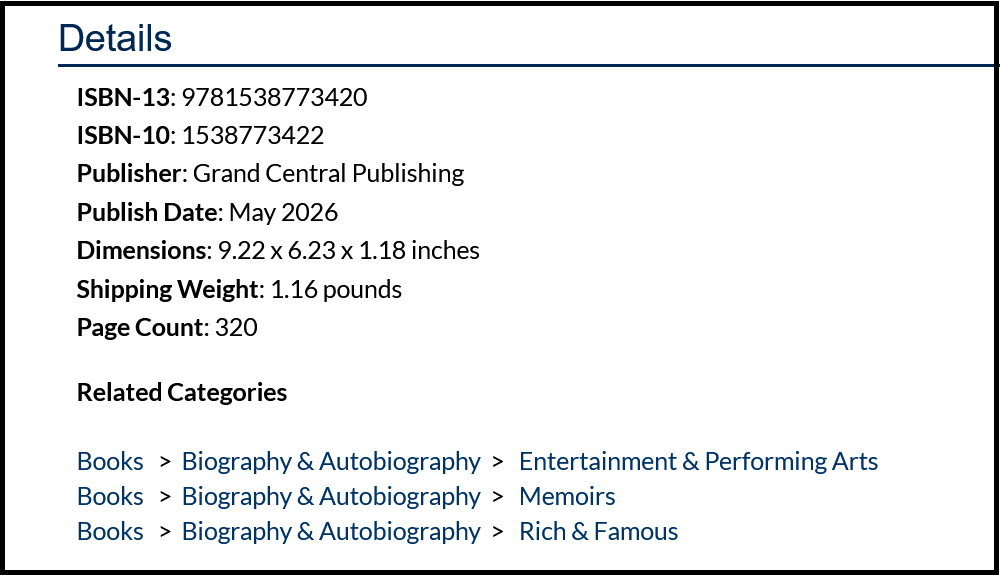
On Books-A-Million’s website, scroll down to the Details section of a book page to see the categories that correspond to BISAC subject codes.
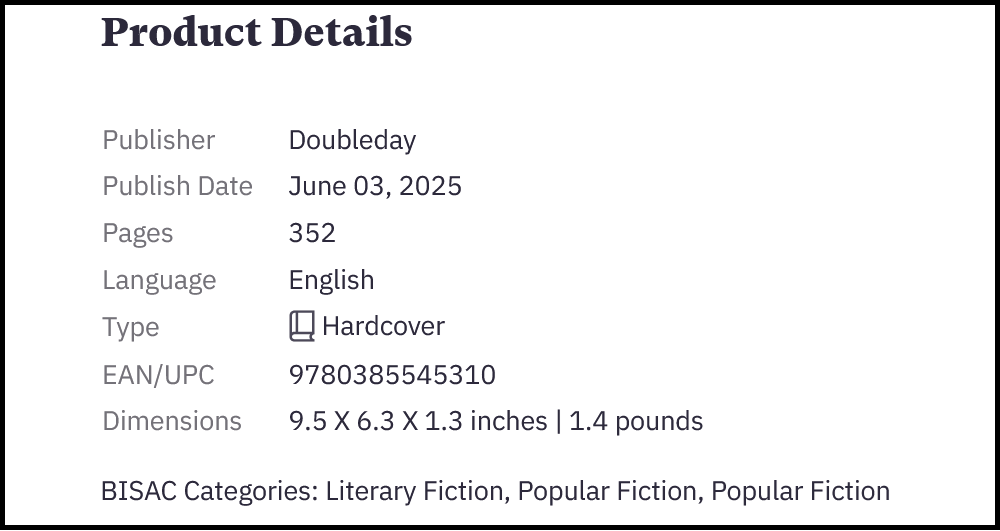
On Bookshop.org, in the Product Details section, you can see a book’s categories; each is clickable, and hovering over them gives the alphanumeric bisac subject code.
Tip 4: Keep BISAC Codes Consistent Across Formats
To prevent confusion and preserve sales and reporting continuity, use the same BISAC codes for ebook, paperback, hardcover, and audiobook formats.
Tip 5: Update Annually
The BISG updates the BISAC list every year. What was a good fit one year might have a more specific, more effective subcategory the next year.
See a summary of recent BISAC changes here.
Check your metadata every year or two to see if new headings have been released that more accurately describe your book; making a change could give your book a “bump” in discoverability.
Summary: Landing the Jump with Your BISAC Subject Codes
Choosing BISAC categories is a small metadata task with outsized impact. Be specific, think like a bookseller, verify platform rules, and check your comps.
Do that, and your book will stop being a ghost on the shelf and start meeting bookstore and library buyers and readers where they already shop.
Take your time. Be specific. And always keep your reader’s needs at the center of your strategy.
Need help choosing BISAC codes? Feeling overwhelmed by the technical side of self-publishing?
You don’t have to go it alone. Whether you’re stuck on metadata, publishing with Amazon KDP or Ingram, or need a launch strategy that actually works, I’ve got you.
I work with American nonfiction authors looking for an extra boost!
➡️See Nonfiction Coaching Services
Check out Working with a Self-Publishing Coach: Claudia’s Success Story to see how personalized guidance can take a book from a draft to a #1 New Release.